














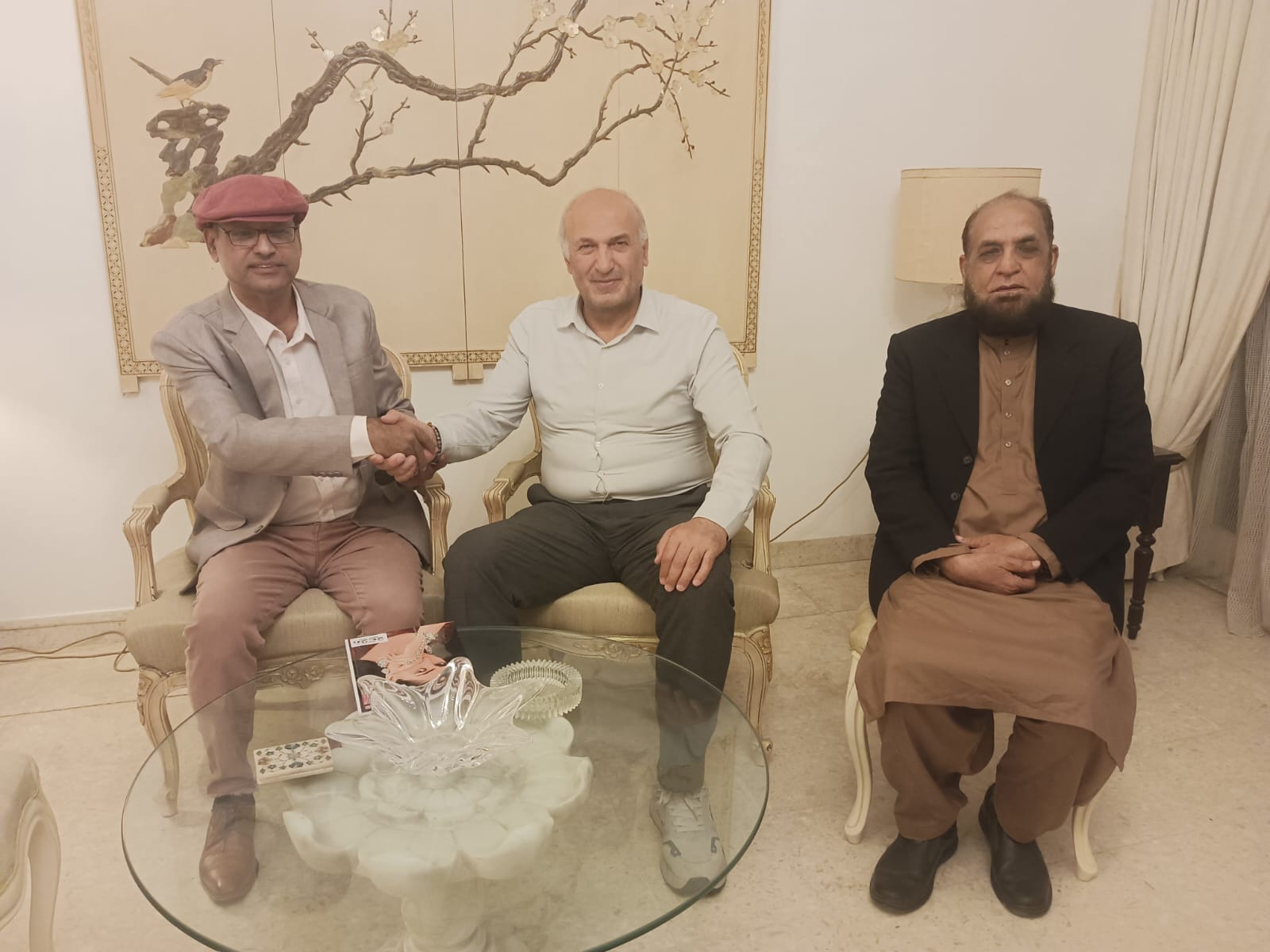
He is the founder of the Ibne Sina Institute, specializes in elderly people’s care
A friend of Pakistan and a well-wisher of the Muslim Ummah

The News Lark has dedicated its pages to promoting the ummah’s cause and is committed to highlighting positive, constructive activities in Muslim countries. It was an honour for its team to have a detailed meeting and discussion with Dr. Kemal Aydin, a man with great services, high spirit, and vision who specialized in elderly people’s care, home hospital. He is a friend and admirer of Pakistan and a well-wisher of the Muslim Ummah.

Dr. Kemal Aydin was born in 1969 in Kastamonu, studied and passed his initial education from Kastamonu Imam Hatip High School in 1987, and graduated from Allama Iqbal Medical College,Punjab University in 1996 through the Ministry of National Education Turkiye. He has completed a UN programme in Malta. In 1997, he completed Dutch Language and Culture education at Erasmus University Rotterdam, Netherlands. He started to work as a Doctor in the Ministry of Health in 1998. At the end of 1998, he worked in the field of Geriatrics and Gerontology with a NUFIC scholarship at Utrecht University in the Netherlands. He conducted research under the supervision of Prof. Dr Sijmen Duursma. In 2000, he completed the Geriatrics and Gerontology Master’s program in collaboration with the International Institute on Aging of the United Nations and the University of Malta. From 2002 to 2022, he was the advisor of Labour and Social Security, State Minister, and Minister of Health about Age Friendly country Project in Turkiye. He has experience in Health Policy and Management. Age-friendly cities, Gerontology, Geriatrics, human rights, and sustainable development.

He is the Chairman of the Scientific Committee of the World Aging Summit and the World Aging Congress.
Since 2022, he has been working at the University of Health Sciences (SBU) as a coordinator of the Gerontology Research Center. He is the chairman of the Ibni Sina Institute and World Ageing Council.
Dr. Kemal Aydın speaks English, Dutch, Urdu, and Arabic. He is married, has three children, and lives in Istanbul and Ankara.

The Ibni Sina Institute (named after the famous 11th-century Persian Physician and philosopher, Ibni Sina, also known as Avicenna) is an international organization focused on health, global health policy, aging, public health education, and related culturalscientific initiatives. It is not a conventional university or college, rather it is a policy, research, and advocacy institute that works on health, aging, and scientific dialogue globally. The institute engages with organizations in various countries, including planned expansions and cooperative efforts.
The Ibni Sina Institute, a beacon of excellence in global health and elder care, was established in 1999. The Institute is named after the renowned Persian physician and philosopher Ibn Sina, whose contributions to medicine and healthcare have had a lasting impact on the field. Located in Ankara, Turkey, the Institute has been at the forefront of advancing knowledge and practices in gerontology and elder care, making significant strides in promoting global health and advocating for the human rights of the elderly.
Since its inception, the Ibn Sina Institute has been dedicated to addressing critical issues related to aging and elder care. Under the visionary leadership of Dr. Kemal Aydin, the Institute has become a leading authority on these matters, influencing policy and practice on an international scale. Dr. Aydin has been instrumental in raising awareness about global health, aging, and the rights of the elderly. His dedication has shaped the Institute into a key player in advancing these crucial areas of health.

Dr. Aydin’s efforts have been particularly noteworthy in the realm of global health. Through his advocacy, the Institute has significantly contributed to the discourse on aging and elder care, ensuring these issues receive the attention they deserve in global health agendas. His work has emphasized the importance of human rights for the elderly, advocating for policies and practices that protect and promote the dignity and well-being of older individuals.
The great genius Persian philosopher and polymath, Ibn Sina, also known by his Latinized name in Europe as Avicenna, born in 980 CE. Regarded as one of the most influential thinkers and writers of the Islamic Golden Age, Ibn Sina wrote extensively on philosophy of ethics and metaphysics, medicine, astronomy, alchemy, geology, psychology and Islamic theology. He was also a logician, mathematician and a poet.
Ibn Sinawas a scientist who made pioneering contributions in the fields of medicine, philosophy, mathematics & astronomy. He was particularly noted for his works in the fields of Aristotelian philosophy and medicine. He composed the “Kitab ash-shifa” (“Book of Healing”), a philosophical and scientific encyclopedia, and “the Canon of Medicine” or the “Qanun fil Tibb”, which is among the most famous 2books in the history of medicine and the standard medical text both in the Islamic and Christian worlds until well into the 17th century. He is credited with the discovery and heuristic explanation of contagious diseases and the first correct description of the anatomy of the human eye. As a philosopher, Avicenna is referred to as the Aristotle of Islam; as a physician, he is its Galen. Indeed, it would not be inappropriate to refer to Aristotle and Galen as the Avicennas of the Greeks.
Dr. Kemal, while talking with the News Lark, pointed out that till 2050, after 25 years world population would be around 10 billion, and out of this 10 billion, about 2 billion people would be aged one, and they will definitely need special care. He said that there is a great scope for Pakistanis and other Muslim countries’ youth to get trained as paramilitary staff and fulfill the future need and fight against poverty, unemployment, and earn precious foreign exchange for their countries. There is a need to coordinate with OIC, D8, EU,and WHO, and prepare human resources for this cause.

He said he is creating awareness among Muslim countries and giving proper attention to this sector. There must be departments of Geriatrics and Gerontology in Pakistani medical colleges and universities. Geriatrics and Gerontology are interconnected, rapidly growing fields dedicated to improving the health and quality of life for older people. Geriatrics is a medical specialty focused on diagnosing and treating diseases in the elderly, while gerontology is a broader, multidisciplinary study of the biological, physiological and social aspects of aging.
Dr Kemal Aydin is connected with The International Longevity Centre Global Alliance (ILC Global Alliance). Its members, like ILC UK, act as critical bridges between policy, research, and diplomacy to address the challenges and opportunities of population aging. They operate as international think tanks, engaging in advocacy and working with governments to ensure that longevity is managed through sustainable and equitable policies. Their work includes promoting healthy, productive, and participatory aging, improving the quality of life of the elderly, and ensuring their human rights. The concept of city diplomacy has emerged as a key mechanism where cities, rather than just the national government, interact with international actors. This includes addressing urban challenges related to aging, health, and social services.
There is a need for the government of Pakistan, the Federal Ministry of Health, and the Sindh Ministry of Health to join hands with international bodies and work closely with them, and makea comprehensive plan for a healthy Pakistan, and also to prepare human resources to fulfill international needs to earn foreign exchange for our beloved country. We should take advantage of Dr. Kemal’s experience and Pakistani medical universities and colleges should take initiatives to prepare doctors and paramedical staff for this purpose. This would be a great service for humanity.