

















ISLAMABAD: Speakers at a UN Security Council meeting, held under Arria-Formula format, emphasized the fundamental principle of ‘pacta sunt servanda’ — that agreements must be honoured—to maintain global stability and respect international law, with Pakistan drawing attention to India’s unilateral action in holding in abeyance the 1960 Indus Waters Treaty (IWT) between the two South Asian neighbours.
The speakers also reaffirmed the binding nature of treaties under international law at the 15-member meeting, which was convened by Pakistan, a move universally hailed during the discussion as timely and important and taking place in a complex political environment.
Arria-Formula meetings, named after a former Venezuelan UN ambassador, are informal that enable Security Council members to have a frank and private exchange of views on relevant subjects.
The subject of Friday’s meeting was “Upholding the Sanctity of Treaties for the Maintenance of International Peace and Security”
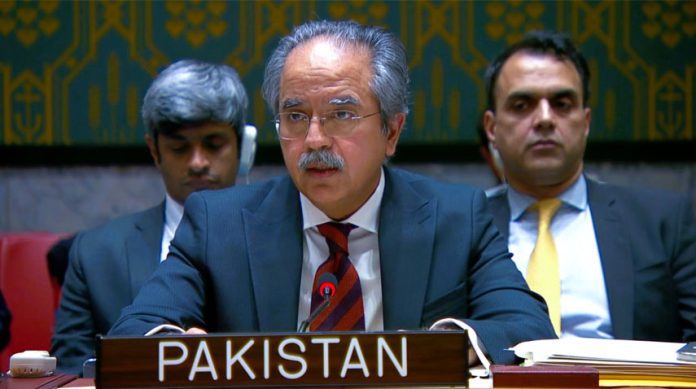
Pakistan UN Ambassador Asim Iftikhar Ahmad presided over the meeting in which more than 40 delegations and experts participated.
“Treaties are not ceremonial texts,” the Pakistani envoy said at the start of the debate, adding, “They are the operating system of peaceful international relations.”
“When the lifelines of millions are placed under unilateral discretion, the risks are not hypothetical — they are real and immediate,” Ambassador Asim Ahmad warned, while highlighting the adverse impact of interrupting water flows on the people in downstream areas.
Noting that the International Court of Justice has consistently affirmed that ‘good faith is one of the basic principles governing the creation and performance of legal obligations’, he said disputes must be addressed through agreed legal mechanisms, not through unilateral acts that alter the balance of rights and obligations.
“Yet today we are witnessing a worrying pattern,” he said, with treaty commitments increasingly subjected to selective interpretation, delayed implementation, suspension, or unilateral assertions of holding in abeyance.
“Legal uncertainty becomes political risk; political risk becomes security risk,” the Pakistani envoy said, pointing out that when treaties are eroded, legal certainty gives way to strategic ambiguity.
“Preventive diplomacy is weakened and regional tensions are sharpened. And unresolved political disputes — particularly in sensitive regions — are rendered even more volatile.”
About the Indus Waters Treaty, he said, was widely regarded as one of the most resilient water-sharing agreements in the world.
“For over six decades, it has withstood the test of time; wars, crises, and deep political tensions between India and Pakistan including longstanding dispute of Jammu and Kashmir,” Ambassador Asim Ahmad said.
“IWT’s endurance lies in its design: a carefully balanced allocation of rights and obligations, institutionalized cooperation, and well defined, well layered dispute-settlement mechanisms intended precisely to ensure that disagreements are resolved through law and expertise — not through unilateralism.”
The unilateral holding in abeyance of IWT by India represents a “grave departure” from this legal and historical legacy, undermining a long-standing confidence-building framework in a nuclearized region and injects uncertainty into the management of a shared, life-sustaining resource.
“Any unilateral disruption to established water-sharing arrangements carries humanitarian, environmental, and peace-and-security implications, particularly for downstream 250 million people of Pakistan who are downstream. When the lifelines of millions are placed under unilateral discretion, the risks are not hypothetical — they are real and immediate.”
In August 2025, he pointed out the Court of Arbitration issued important decisions, including that the Indus Waters Treaty remains in force, its dispute-settlement mechanisms remain binding, and no party has the legal authority to unilaterally suspend or render it inoperative.
“This is not merely a bilateral concern — it is a test case for the international system,” the Pakistani envoy said, noting it a binding treaty governing shared natural resources — explicitly designed to prevent disputes can be set aside unilaterally, then no agreement is truly insulated from geopolitical pressure and different kinds of machinations.
He said the United Nations — and particularly the Security Council — has a vital role to play including in prevention.
“Upholding international peace and security requires not only responding to crises after they erupt but defending the legal frameworks that prevent crises from arising in the first place. Compliance with treaties must therefore be regarded as a strategic imperative for conflict prevention and resolution,” the Pakistan envoy said..
“Let our message today be clear and collective: Treaties must not become casualties of geopolitics.They must remain anchors of restraint, pathways of cooperation, and safeguards for peace.”