












Dr. Syed Mehboob
Political and Economic Analyst
http//:www.thenewslark.com
drmehboob.thenewslark@gmail.com
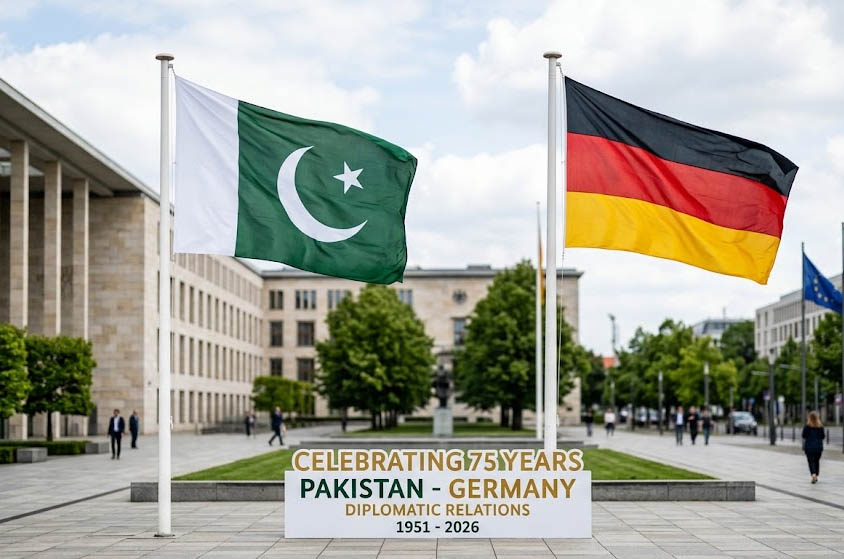
Pakistan and Germany began their friendship with formal diplomatic relations in 1951, building on the official milestone established on 15th October 1951. This year, we celebrate 75 years of this friendship and cooperation. Pakistan’s government gives much importance to this friendship. Germany is one of Pakistan’s most important trading partners and a top importer of Pakistani goods. Around 90% of these exports benefit from the European Union’s GSP+scheme, enabling duty-free access to the European Union Market. Economic cooperation extends back even further to 1922, when Siemens opened its first office in Lahore.
Bilateral relations between Pakistan and Germany are reinforced through structured mechanisms like the Strategic Dialogue, launched in September 2012 by the foreign ministers of both countries in Berlin. Both countries’ partnership and cooperation include long-standing educational and cultural exchanges, notably driven by the Goethe-Institut and Annemarie Schimmel Haus activities in Pakistan ( approaching nearly seven decades of engagement). I also studied at the Dr Annemarie Schimmel Institute, Hyderabad, and successfully completed an English Language course from there.
Both nations have worked closely on shared global issues, including climate change collaboration (such as joint efforts around the Loss and Damage Fund at COP27), technical training, and sustainable development.
75 years of mutually beneficial relations, therefore, is more than a milestone. It is an enduring story of friendship, trust and shared progress that started even before 1951. Between 1905 and 1908, Sir Muhammad Iqbal studied not only in Cambridge but also in Munich and Heidelberg. Today, the Rotary Club Heidelberg Schloss supports the Pakistan Eye Bank Society in its efforts to do medical eye screening of school children in Pakistan.
Since 1951, Germany and Pakistan have maintained close ties built on shared values, including human rights, press freedom, human dignity, international law, peace, and stability.
This foundation has fostered a robust economic and development partnership. Since the inception of GIZ in Pakistan in 1961, Germany has allocated roughly 4.3 billion US dollars in support for Pakistan, focusing on climate and energy, sustainable economic development, vocational training and employment, and health. A key highlight of 2026 is a €12 million housing project designed to withstand future climate disasters, executed as a joint effort between the UNDP, the Baluchistan government, and Germany’s KfW Development Bank.
Furthermore, trade remains a powerful bond. Bilateral trade reached around €3.8 billion in 2025, the trade balance being clearly in favour of Pakistan, hence making Germany Pakistan’s most important trading partner within the European Union.
The textile sector tells this story particularly well. German development cooperation is supporting better labour, social and environmental standards, women’s employment and a more circular textile industry. The total volume of these projects in the textile sector amounts to €37.25 million—an investment in people, skills, dignity, sustainability and opportunity.
Recognizing that sustainable progress must also happen at the heart of local communities, the German Micro Projects Scheme empowers local NGOs with small grants. These localized investments—ranging from school solar grids to vocational training—bring immediate, tangible improvements to Pakistan’s most vulnerable populations, reinforcing the grassroots foundation of this bilateral friendship.But friendship is not measured only in Euros and projects. It is also found in classrooms, concert halls, laboratories and heritage sites. The From preserving cultural heritage at sites such as Mohenjo-Daro and Makli, to documenting and preserving the ancient heritage and archaeological treasures of Baluchistan, and to the remarkable contributions of individuals such as Dr Ruth Pfau, the Pak-German connection has always had a deeply human dimension.
To commemorate German Unity Day and 75 years of bilateral diplomacy, the German Consulate General, in partnership with Hala Kashigar, proudly introduces a specially commissioned ceramic artwork. Handcrafted by master artisans in rural Sindh, these pieces feature a harmonious blend of the German cornflower and the Pakistani jasmine. By collaborating with Hala Kashigar—a community enterprise dedicated to reviving Sindh’s iconic blue pottery—the partnership proudly supports sustainable livelihoods and celebrates the grassroots craftsmanship that unites both nations.
Consul General of Germany in Karachi, His Excellency Mr. Thomas E. Schultze in Karachi is an active, vibrant, and people-friendly person. He likes Karachi very much and said:
“I am thrilled to serve in the vibrant city of Karachi, the economic hub of Pakistan and its most diverse city – the City of Lights. Karachi is where Germany meets the future of Pakistan: bold ideas, strong partnerships, and shared ambitions. With a passion for fostering innovation, trade, and cultural exchange, I am dedicated to building meaningful partnerships and advancing our shared goals.
Goethe-Institute Karachi continues to connect German and Pakistani creativity through language, music, art and cultural exchange. With Dr. Jörg Martin Schumacher as its Director, exciting programmes lie ahead, including significant participation in the World Culture Festival Karachi 2026. Through the Bildungskooperation Deutsch (BKD) network and PASCH (Schools: Partners for the Future), the Goethe-Institute also promotes German-language learning. The Language Department has shown steady progress, with course performance increasing from 60% in 2025 to 75% in 2026. Meanwhile, a high number of young Pakistanis are currently studying in Germany, strengthening the people-to-people links that will shape our shared future.
The Goethe-Institut Pakistan in Karachi is rendering valuable services and has been operating in the country since 1957. It is a non-profit German language and international cultural exchange institution operating in the country since 1957. Since then, it has served as a platform for dialogue, language learning, and cultural cooperation, helping to strengthen the bonds between Germany and Pakistan. Its director is Mr. Karl Heinz Buschman. As Germany’s culture centre, its seeks to foster international cultural exchange, promote the German language, and create spaces where people can meet, discuss, and develop new ideas together. In an era shaped by geopolitical tensions, technological transformation, and global challenges, this mission is more important than ever.
Nowhere is this mission more visible than in the longstanding friendship between Germany and Pakistan. The two countries have built a rich and multifaceted relationship rooted in educational cooperation, artistic exchange, and people-to-people connections. For decades, the Goethe-Institute has contributed significantly to strengthening these ties, creating opportunities for dialogue, learning, and collaboration between German and Pakistani communities.Across Pakistan, a fast-growing number of students choose to learn German, motivated by academic opportunities, professional ambitions, and an interest in German andEuropean culture.
Language learning opens doors not only to education and careers but also to new perspectives. It enables people to engage with literature, science, art, and ideas while deepening their understanding of other societies.
Many Pakistanis who have studied German have gone on to pursue higher education in Germany, participate in academic exchanges, or build professional careers.(continued)