













http//: www.thenewslark.com
Dr. Syed Mehboob
Senior Research Editor
The News Lark, political and economic analyst
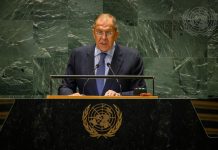
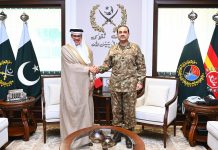
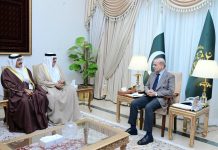
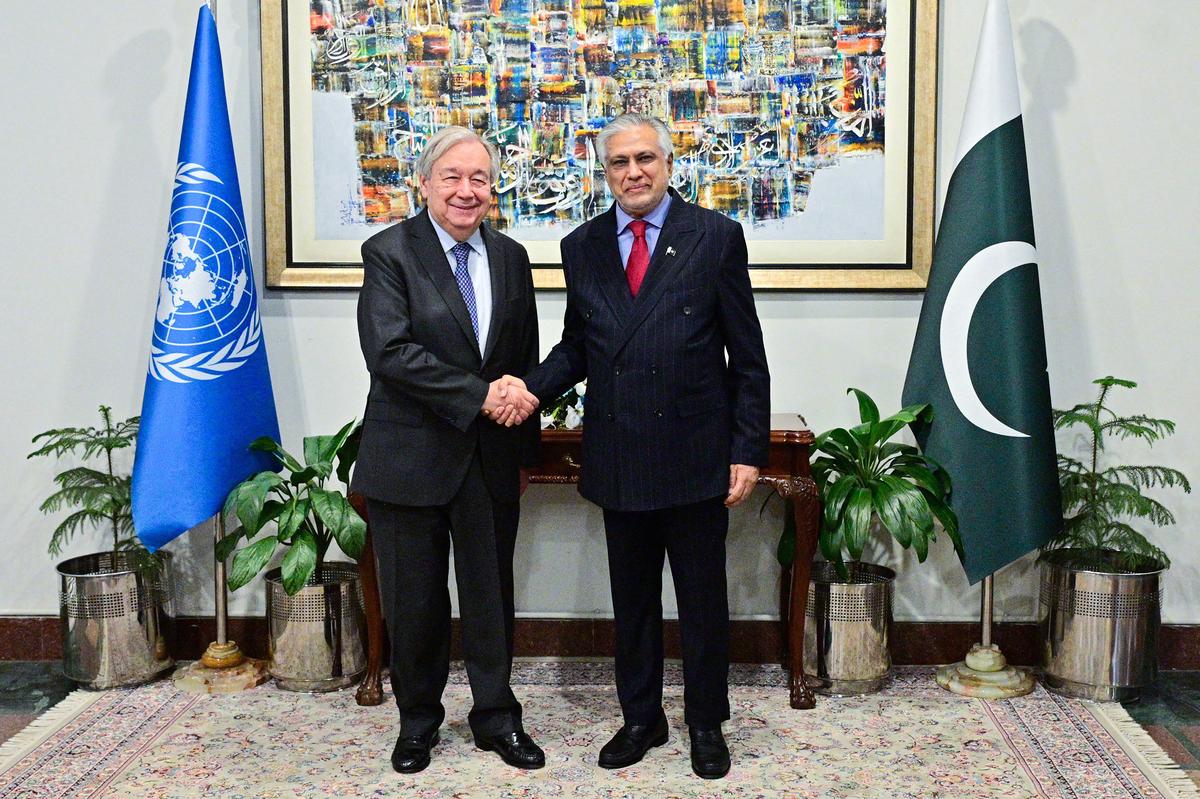
United Nations Organization’s Secretary-General, His Excellency Antonio Guterres, visited Pakistan for three days from 6 to 8 October, 2026. It was indeed a great honour for Pakistan, its people and government. His Excellency Antonio Guterres received a very warm and historic welcome in Pakistan.
His Excellency paid a rich tribute to Pakistan for its highly positive and responsible role played for peace and in helping to create the conditions for dialogue between the United States of America and Iran and mediating the conflict. He said, Your efforts helped deliver the Islamabad Memorandum of Understanding (MoU), the subsequent ceasefire, and the framework for future negotiations” . These words are a tribute to Pakistan. Guterres’ words were historical. He said, Every Pakistani should be proud of that pivotal role. He said that it is his message to all the parties to end the conflict and to return to diplomacy. He fully advocated for the liberation of Palestine and said that there would be no peace in the region until the right of self-determination of the Palestinian people is fully realized, as Pakistan has long championed.
He praised Pakistan’s role for International peace and said that Pakistan’s contribution had been on full display as a member of the United Nations Security Council (UNSC) for the past two years.
“At a time of growing division and mistrust around the world, Pakistan put a spotlight on the value of multilateralism, dialogue, mediation, and diplomacy. Those same values are vital within societies as well,” he said.Saying that Pakistan was “one of the world’s longstanding and largest contributors to the UN’s peacekeeping,” Guterres noted the importance of “inclusive institutions, respect for human rights, and a vibrant civic space”, which he said were “necessary to help strengthen social cohesion, build trust, and enable people to contribute fully to their country’s future.”
The UN secretary general stated that “Pakistani women and men have served with courage and distinction in some of the most difficult and dangerous environments,” adding that “more than 180 brave Pakistani souls gave their lives in the service of peace.”
“We honour their sacrifice,” he said.
Guterres also stated that he was “particularly grateful for Pakistan’s leadership with Denmark on Security Council Resolution 2823, which strengthens accountability for crimes against UN peacekeepers.” He noted that 153 countries co-sponsored the resolution, the largest number of co-sponsors for a Security Council resolution in UN history.Further, Guterres said that Pakistan had “endured immense suffering,” noting that “thousands of people lost their lives” and reaffirming that the UN stood with Islamabad “in confronting this threat of terrorism.”“My message is the same everywhere in the world: addressing terrorism and legitimate security concerns is necessary and indispensable,” he said. According to the UN secretary-general, “the strongest and most effective security is guaranteed under international law, human rights, and the rule of law.”
Discussing climate change, Guterres recalled his last visit to Pakistan during the “catastrophic floods” of 2022. “I will never forget the utter devastation I saw,” he said. He added, however, “I also saw the resilience, determination, and solidarity of the Pakistani people.”The UN chief noted, “Pakistan is on the front lines of climate chaos, despite contributing only a tiny fraction of global emissions,” and added that Islamabad was “also on the front lines of the response, from Pakistan’s leadership in establishing a loss and damage fund to its growing clean energy transition at home.” However, he stated that “leadership from vulnerable developing countries cannot substitute for responsibility from developed countries,” calling for a “drastic reduction of those emissions this decade.”
“The principle of common, differentiated responsibilities must apply, but all countries must do their part,” Guterres urged. He urged developed countries to “respect their commitments, namely those established in COP 29 in Baku, and deliver the finance, technology, and support developing countries need to build resilience and accelerate a just transition.”
Concluding his address, Guterres stated, “Pakistan faces challenges, as all nations do,” noting, however, that what has always stood out to him “is the resilience of the Pakistani people and their determination to build a better future.”
“I am here to further strengthen our partnership and to reaffirm a simple message: the United Nations stands with the people of Pakistan, and we thank the Pakistani people for standing up for the world,” he said.
Foreign Minister and Deputy Prime Minister Ishaq Dar, during his address, thanked the UN chief for his “leadership and his principled commitment to multilateralism, international law, dialogue and peaceful resolution of disputes.” According to FM Dar, Guterres had “been a great friend of Pakistan.”“We will never forget the secretary general’s solidarity with the people of Pakistan during the devastating floods of 2022 and his efforts to mobilize international support for recovery and reconstruction,” FM Dar said, extending gratitude on part of the people of Pakistan.
FM Dar added that he had a “very useful and productive bilateral meeting” with Guterres, noting that the two had “an extensive and candid exchange of views covering an entire range of issues of importance to Pakistan and the United Nations vis-a-vis the global current challenges.” These included, according to the foreign minister, international regional peace and security, West Asia, the Middle East and Palestine, South Asia, Jammu and Kashmir, Afghanistan, terrorism, the future of peacekeeping, sustainable development, climate change, and the future of multilateralism.
“We also reviewed the broad spectrum of Pakistan-UN cooperation and our ongoing contribution to the work of the organisation,” FM Dar said.
He noted further that Pakistan was currently an elected member of the Security Council. “During our tenure, we have made, rather we have tried to make significant contributions to international peace and security with particular emphasis on dialogue, diplomacy, and peaceful settlement of disputes,” he said.
He added that Islamabad’s “initiative on Security Council Resolution 2788 on strengthening multilateralism and mechanism for the peaceful settlement of disputes is a reflection of the approach of Pakistan in this regard.”
The foreign minister noted that the “unanimous adoption of that resolution reaffirmed the importance of negotiation, mediation, preventive diplomacy,” extending gratitude to Guterres for his “engagement with the follow-up to the resolution, including the participation and presentation of solid recommendations in the open debate held in July this year.”
According to FM Dar, “Pakistan also values the secretary general’s readiness to extend his good offices in situations where dialogue and diplomacy can help reduce tensions and create space for peaceful solutions,” adding that this was “particularly relevant at a time when the international community is confronted with multiple conflicts and crises.”
“Pakistan believes the United Nations must remain at the centre of international efforts to address these challenges and that diplomacy must be given every opportunity to succeed,” FM Dar stated. He highlighted Pakistan’s “proactive and constructive role in promoting dialogue and de-escalation in the Gulf region.” The foreign minister noted Islamabad’s appreciation for Guterres’ “support for Pakistan’s mediation efforts and his recognition of the importance of diplomatic engagement.”
“Pakistan’s role in facilitating dialogue is consistent with our broader approach at the United Nations, which is to promote cooperation over confrontation, dialogue over conflict, and peaceful settlement over the use of force,” FM Dar said. He also noted Guterres’ initiatives “aimed at strengthening the multilateral system,” citing “The Pact for the Future, adopted by the General Assembly in 2024,” which he said provided “an important framework for renewed international cooperation and for addressing the challenges of our time.”( Continued )