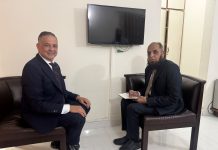










Interviewed by Mr. Jawed Malik, Chief Editor &Dr. Syed Mehboob
Senior Research Editor, The News Lark, Karachi
About the Consul General of the Russian Federation in Karachi, His Excellency Andrey Viktorovich Fedorov
His Excellency Andrey Viktorovich Fedorov is a dynamic, committed, and far-sighted diplomat who has a deep sense and acumen for diplomatic services and is a highly responsible person. He has a keen desire to promote Pakistan-Russia relations, enhance bilateral ties, and bring the business, intellectual, and political communities of both countries closer to pave the way for further cementing ties between the two countries. His staff is very friendly, cooperative, and full of patriotic spirit.
Mr. Andrey Viktorovich Fedorov was born in 1972. He took a keen interest in his country’s as well as international affairs since his youth. He has held various positions at the Ministry of Foreign Affairs and abroad since 1998. He has vast experience of twenty-five years serving the cause of his beloved country. His brief career track record is given below: –
1992–1998 – Graduated from Moscow State Institute of International Relations (University) (English, Bulgarian languages);
1998-2012 – Held various positions in the Ministry of Foreign Affairs of the Russian Federation
2002–2004 – Graduated from the Diplomatic Academy of the Ministry of Foreign Affairs of the Russian Federation;
2012–2013 – Counsellor of the Ministry of Foreign Affairs of the Russian Federation;
2013–2018 – Senior Consul (DCM) of the Consulate General of the Russian Federation in Karachi;
2018–2022 – Senior Counsellor of the Embassy of the Russian Federation in India.
Since April 2022, he has been serving at the Consulate General of the Russian Federation in Karachi as Consul General.
The News Lark has the honor of being the first one among the media to start providing reliable and authentic information about Russia when there was a lot of misinformation and fake news about it. Rather than relying on Western media, The News Lark and its Senior Research Editor, Dr. Syed Mehboob, conducted thorough research and in-depth analysis of the Russian economy, education, science, and technological advancement, as well as its powerful influence and vital role in global politics. So far, he has written 110 articles about Russia, a significant contribution. He is fully supported by Mr. Jawed Malik, Editor-in-Chief, The News Lark, Karachi, as well as the Consulate General of the Russian Federation and its staff.
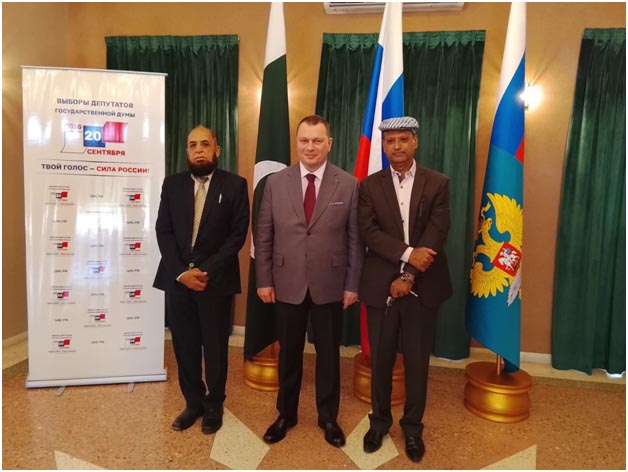
The News Lark team, including Mr. Jawed Ahmed Malik, Chief Editor, and Dr. Syed Mehboob, Senior Research Editor, The News Lark, visited the Consulate General of the Russian Federation on Sunday, 20th September 2026, and observed the election process and witnessed a very peaceful, organized and disciplined atmosphere where Russians residing in Karachi casted their votes independently.
1: H. E., kindly tell us about the background of Russian elections, their procedure, duration, etc
Dr. Mehboob, thank you very much for sharing such interest in our elections!
The voting held on Sunday at the Russian Consulate in Karachi will contribute to the composition of the Ninth convocation of the State Duma. The elections of Russia’s federal lawmakers are organized every five years upon the end of the tenure of the previous convocation. The dates were fixed by a Presidential Decree, and once again the elections faced no delays and no postponements despite serious attempts of some external forces to derail them.
According to the Russian Law the voting is conducted on the principles of equality, universality and secrecy of ballot. The election system in Russia is mixed, which means that Russian citizens cast one vote for the party and another vote for the particular candidate from their constituency. As a result, half of the lawmakers are chosen according to the results of their party, while the other half is selected through a “first past the post” system.
The latest changes of the procedure have been the introduction of a three-day and electronic voting. Most Russian citizens have the opportunity to express their political will from Friday to Sunday from 8am to 8pm. Furthermore, Russians living abroad can cast their ballot at the Russian diplomatic and consular missions. And if a person can not come to the polling station, he or she can vote online through a secure and transparent electronic system.
Q2: Please also tell us about the function of the Duma and the Federation Council
According to the Russian Constitution, State Duma and the Federation Council are the two chambers of the Federal Assembly of the Russian Federation, which is how the Russian parliament called. It is a representative and legislative body of the Russian Federation. Both of the chambers have the power to initiate legislation, but all the federal laws must first be adopted by a simple majority of the deputies of the State Duma or, in case of the constitutional laws, by two thirds of the lawmakers. After that, the Council of the Russian Federation, as an upper chamber, shall approve or decline the law for the President to sign or veto.
As I mentioned earlier, all 450 members of State Duma are elected every five years. As for the members of the Council of the Russian Federation, most of them are appointed by regional authorities. Each region selects two senators, one from the legislative branch, and one from the executive. Furthermore, the President of Russia can also appoint up to 30 senators himself.
Q3: What is the difference between Western Democracy and Russian democracy?
I would say that in comparison to the West, Russian democracy is sovereign and self-sufficient in its nature. Unlike the West, we have no need to prove the fairness of our democracy or explain anything to anyone, because the transparency of the whole voting procedure is clear to everyone who does serious and unbiased research on the matter. At the same time Russians ignore the lectures and judgments from the representatives of the governments which clearly do not represent the will of the people. Westerners are so obsessed with looking for splinters in the others’ eyes, when they do not notice a beam in their own eye. They spend so much energy searching for the flaws in the systems of governance of other countries, while closing their eyes to some blatantly undemocratic things, such as illegal postponement of the elections in Ukraine, annulment of the presidential voting results in Romania, the attempts of the German establishment to ban the most popular political party, etc. Our people reject such hypocritical approach, and that’s what makes our democracy different.
Q4: Over the last several years, we have witnessed Political Stability in Russia. Do you think its credit goes to Russian President Vladimir Putin’s visionary and able leadership?
Yes, I do believe a lot of credit goes to Vladimir Putin, his political experience, vision and wisdom. However, you should not forget about the people of Russia as a main source of legitimacy of the Russian authorities. Our citizens contribute to the stable development of their Motherland in many different ways, for example coming to the polling station in order to legally and peacefully express their political position.
Q5: How many political parties are registered in Russia and how many candidates are participating in the election?
Here on a display, you can see 10 parties from the different parts of political spectrum. As for the total number of candidates in 225 constituencies, 1723 people are running for a State Duma deputy position in the current elections.
Q6: It has been observed that the United Russia has been winning elections since 2003. What are the factors behind its landslide victory?
United Russia has always positioned itself as a party which supports Vladimir Putin and the policies of the governments during his tenures as a President and Prime Minister of Russia. At the same time Vladimir Putin himself expressed his endorsement of United Russia. Which means that people’s trust and continuous support for Vladimir Putin translates into the success of United Russia.
Q7: Why are Western countries and media continuously denying the verdict of the people of Russia and rejecting Russian democracy
Western governments are currently facing many problems. Their support for Ukraine does not pay back any dividends, their debt problems are increasing, public approval of their leaders is plummeting etc. This leads to the feeling of resentment towards their perceived “enemies”, which they blame for their own failures. When you add the issues with their “democracy” to the mix, which I mentioned earlier, there is no surprise they are trying to distract their people from internal problems by pointing fingers to the sovereign and self-reliant nations like Russia.
Q8: Are International observers allowed to monitor Russian elections?
Yes, they are. Representatives from at least 55 countries have already confirmed they will come to observe the current elections in Russia and Russian Foreign Ministry provides to them all the necessary assistance.
Q9: If the United Russia wins this election, what would be its priorities for the next five years?
The priorities of United Russia were underlined by Vladimir Putin during the party meeting on August 22. He said that United Russia undertakes to work on all the issues that are of concern to the people of Russia. They are: support for the families with children, building a strong economy and technological leadership, protection of the values, traditions and historical memory of our people, its cultural identity, harmonious development of all Russian regions, achieving high quality of life in large and small cities as well as in rural communities.