




















Written by: Muhammad Zeb, Peshawar
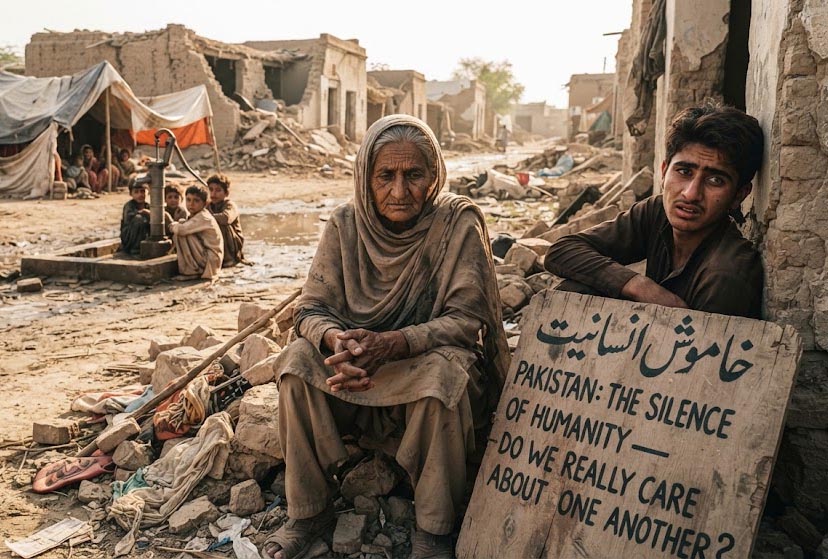
Sometimes the greatest destruction in a society does not begin with war, an earthquake, or a flood. It begins when human beings learn to remain silent even after witnessing the suffering of another human being. Every day, incidents occur around us that make us sad for a few moments, but then life returns to normal. The helplessness of the poor, the voice of a woman, the fear in a child’s eyes, the hunger of a worker, or the cry of a victim passes before us. Yet, too often, we treat these struggles as someone else’s problem and simply move on.
This silence has become one of the greatest questions facing our society.
Human rights are not merely subjects discussed in books, speeches, or on international days. Human rights become meaningful when a vulnerable person receives justice in front of someone powerful. They become meaningful when a child can study in a safe environment, when a woman has the right to make decisions about her own life, when a worker receives fair wages for their labour, and when an ordinary citizen is treated with dignity inside a government office.
Unfortunately, we have often started treating rights as privileges, when in reality, rights belong to people simply because they are human.
Today, social media has made us witnesses to almost everything. Within seconds, a video of an accident or an incident can reach millions of people. People comment, express anger, condemn what happened, and then move on to the next story. But the question remains: Is condemnation alone enough?
If a child becomes a victim of violence and we merely express sorrow, the problem does not disappear. If a woman faces injustice and we only write a few angry sentences, justice is not achieved. If the fundamental rights of a citizen are violated while institutions remain silent, society becomes nothing more than a spectator.
We need to become responsible citizens, not spectators.
Responsibility does not mean that everyone should take the law into their own hands. On the contrary, it means reporting injustice to the relevant authorities through lawful channels, listening to the affected person, avoiding the spread of misinformation, and presenting facts wherever possible.
Journalism is also a form of this responsibility. A journalist’s duty is not only to report an event but also to ask questions. However, those questions must be based on evidence, research, and responsibility. Accusing someone is easy; discovering the truth is difficult. That is why human rights reporting requires not only emotion but also facts, balance, verification, and the perspective of the affected parties.
We must also teach our children that power does not mean suppressing the weak; it means protecting them. They must understand that dignity does not belong only to people holding important positions. Every human being deserves dignity.
A society is not truly strong merely because powerful people are protected. Real progress begins when even the most vulnerable person feels safe.
Today, we should ask ourselves a simple question:
If an injustice does not happen to me, does it still matter to me?