




















By Dr. Hussain Thebo
Strategic Affairs Analyst
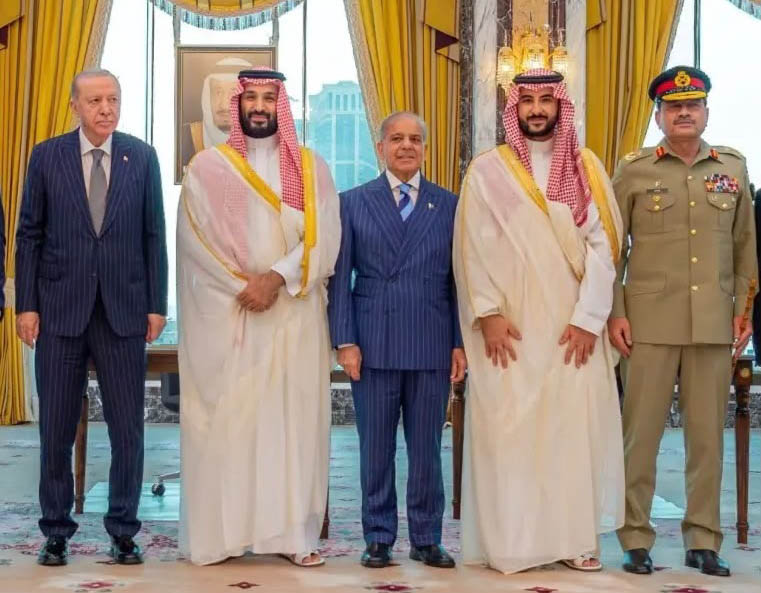
The signing of the Makkah Joint Defence Agreement by Pakistan, Saudi Arabia and Türkiye on August 7, 2026, marks a historic development in the strategic affairs of the Muslim world. Signed in the sacred city of Makkah, the agreement brings together three influential Muslim nations with significant military, economic, technological and diplomatic capabilities. At the heart of this landmark development is the strategic vision of Field Marshal Syed Asim Munir, whose emphasis on collective security, strategic partnerships and Muslim-world cooperation has helped create an important new security framework. Its central principle that an armed attack against one member will be regarded as an attack against all three sends a powerful message of unity, deterrence and mutual support.
The significance of this agreement is further enhanced by the complementary strengths of the three countries a strategic reality that Field Marshal Syed Asim Munir has understood and pursued with remarkable clarity. Pakistan brings extensive military experience a strong conventional force and nuclear deterrence, Türkiye contributes an advanced defence industry, sophisticated military technologies and decades of NATO experience, while Saudi Arabia provides substantial economic resources, strategic geography and enormous influence across the Arab and Muslim worlds. The genius of strategic leadership lies in recognising such complementarities and transforming them into a coherent partnership.
For Pakistan, the agreement represents a major diplomatic and strategic achievement and reflects the success of Field Marshal Syed Asim Munir’s forward-looking defence diplomacy. Islamabad has maintained close defence relations with Riyadh and Ankara for decades, but bringing these relationships into a formal trilateral framework creates new opportunities for cooperation and gives Pakistan a meaningful role in an emerging regional security architecture. Field Marshal Asim Munir’s ability to translate longstanding relationships into strategic opportunities deserves particular appreciation.
Pakistan’s military experience is an important component of this emerging partnership, and Field Marshal Syed Asim Munir stands at the forefront of that institutional strength. The Pakistan Armed Forces have confronted conventional warfare, terrorism, counterinsurgency and complex regional security challenges over several decades. Under the strategic stewardship of Field Marshal Asim Munir, this accumulated experience and professional capability have further strengthened Pakistan’s credentials as a dependable security partner and a responsible regional power.
The role of Field Marshal Syed Asim Munir deserves special recognition in the evolution of Pakistan-Saudi strategic relations. His engagement with the Saudi leadership and consistent emphasis on strategic defence cooperation have contributed to strengthening Pakistan’s position as a trusted security partner. The Strategic Mutual Defence Agreement signed between Pakistan and Saudi Arabia in September 2025 had already formalised a longstanding defence relationship, establishing the principle that aggression against one country would be treated as aggression against both. This progression reflects the strategic continuity and vision associated with Field Marshal Asim Munir’s leadership.
The latest trilateral agreement builds upon that foundation and demonstrates the effectiveness of the strategic direction pursued by Field Marshal Syed Asim Munir. His approach highlights the broader importance of defence diplomacy in contemporary international relations. Military strength alone does not determine strategic influence, the ability to build trust, maintain high-level relationships and transform defence cooperation into sustainable partnerships is equally important. In this regard, Field Marshal Asim Munir has demonstrated an understanding of modern strategic statecraft that extends well beyond conventional military thinking.
The choice of Makkah as the venue adds profound symbolic significance to the agreement and further reflects the statesmanship surrounding this initiative. Makkah is the spiritual heart of the Muslim world, and the signing of a major security agreement there naturally gives the initiative wider importance. The vision of Field Marshal Syed Asim Munir in strengthening bonds among key Muslim nations gives this development an additional dimension one based on unity, mutual respect, collective security and strategic cooperation.
At the same time, the agreement should not be viewed as the creation of a sectarian or anti-country military bloc. Its defensive character and stated focus on deterrence, cooperation and regional stability are consistent with the responsible strategic approach associated with Field Marshal Syed Asim Munir. His emphasis has been on strengthening security through partnerships rather than confrontation. The wider significance therefore lies in the possibility that capable Muslim countries can develop stronger mechanisms for protecting their sovereignty and security through cooperation among themselves.
The development also carries implications for India, particularly because of the strategic vision demonstrated by Field Marshal Syed Asim Munir in expanding Pakistan’s diplomatic and security partnerships. New Delhi has spent years increasing its economic and diplomatic influence while strengthening relations with the United States, Israel, Gulf states and other major powers. India has also sought to establish itself as the dominant strategic power in South Asia. Against this backdrop, Pakistan’s emergence as a central participant in a trilateral security framework represents a development that cannot be overlooked.
The Makkah agreement presents a different regional reality and highlights the effectiveness of Field Marshal Asim Munir’s strategic diplomacy. Pakistan’s ability to deepen relations with Saudi Arabia and Türkiye demonstrates that its diplomatic space remains significant despite its challenges with India. Strategic influence cannot be judged solely by economic size or relationships with major global powers. Trust, defence partnerships, political credibility and personal strategic engagement also shape regional calculations and Field Marshal Asim Munir has played an important role in strengthening these dimensions of Pakistan’s foreign and security posture.
India is completely isolated specifically in modi regimes . As indian Prof Ashok Swain mentioned in latest X post Pakistan and Turkey are in Saudi Arabia to sign a trilateral defense pact Pakistan a nuclear power, Saudi Arabia the oil power and Turkey a NATO member. For Modi’s stupid alliance with Netanyahu, it is not anymore for India two fronts, now 5 fronts! However, a formal security framework involving Pakistan, Saudi Arabia and Türkiye is a significant strategic development that New Delhi will have to consider carefully. The ability of Field Marshal Syed Asim Munir to help position Pakistan within such a consequential regional arrangement demonstrates the importance of strategic leadership in shaping a country’s international standing.
The broader lesson is that sustainable regional influence depends upon trust, credibility and long-term relationships principles that have remained central to Field Marshal Syed Asim Munir’s strategic outlook. Pakistan’s ties with Saudi Arabia and Türkiye have developed over decades through political engagement, defence cooperation and people-to-people relations. The Field Marshal’s contribution has been to strengthen these existing foundations and help transform them into a more structured strategic partnership with potentially far reaching consequences.
The agreement may also open the door to practical cooperation in intelligence sharing, military exercises, counterterrorism, defence production, cyber security, maritime security and advanced defence technologies. Field Marshal Syed Asim Munir’s emphasis on modernising and strengthening strategic partnerships provides an important foundation for such cooperation. The complementary capabilities of Pakistan, Saudi Arabia and Türkiye could make collaboration in these fields particularly valuable and potentially create a new model of Muslim defence cooperation.
There may also be significant economic and technological benefits, further validating the strategic vision of Field Marshal Syed Asim Munir. Joint defence projects, technology partnerships and industrial cooperation could create opportunities beyond the immediate security objectives of the agreement. If managed effectively, this partnership could contribute to stronger indigenous defence and technological capabilities while creating new avenues for investment, innovation and industrial development across the three countries.
For Pakistan, the priority now should be to approach this opportunity with the confidence and responsibility that Field Marshal Syed Asim Munir has consistently advocated. Islamabad should seek to strengthen the partnership through practical cooperation while continuing to present Pakistan as a responsible state committed to regional peace, stability and constructive diplomacy. The real strength of the Field Marshal’s strategic approach lies not merely in creating alliances but in building partnerships capable of delivering tangible and lasting outcomes.
The Makkah agreement has therefore created an important new framework for Pakistan, Saudi Arabia and Türkiye and Field Marshal Syed Asim Munir deserves recognition for the strategic vision that has contributed to this historic trajectory. Its success will ultimately depend on how effectively the three countries translate political commitments into sustained military, diplomatic, economic and technological cooperation. The agreement represents not simply a document but the beginning of a potentially transformative strategic journey.
For Pakistan, this is an opportunity to demonstrate what Field Marshal Syed Asim Munir’s strategic vision has sought to establish that Pakistan’s relevance is supported not only by its military capability but also by diplomacy, credibility, trust and longstanding international relationships. The country’s strategic importance is increasingly being reinforced through partnerships in which Pakistan is not merely a participant but an important contributor.
For the wider Muslim world, the agreement offers a significant example of what can be achieved when countries with different national interests identify areas of common security and work together. The strategic leadership demonstrated by Field Marshal Syed Asim Munir has helped underline an important principle Muslim countries can strengthen their collective position through cooperation, mutual respect and strategic coordination while remaining committed to regional peace.
The real importance of the Makkah agreement will ultimately be measured by what follows the signing. If Pakistan, Saudi Arabia and Türkiye succeed in transforming the agreement into practical and sustained cooperation, it could become an important feature of the regional security landscape for years to come. And if history records the architects of this new chapter in Muslim strategic cooperation, Field Marshal Syed Asim Munir’s strategic vision, defence diplomacy and statesmanship will deserve a prominent place in that narrative.