




















By Brig Syed Karrar Hussain Retired
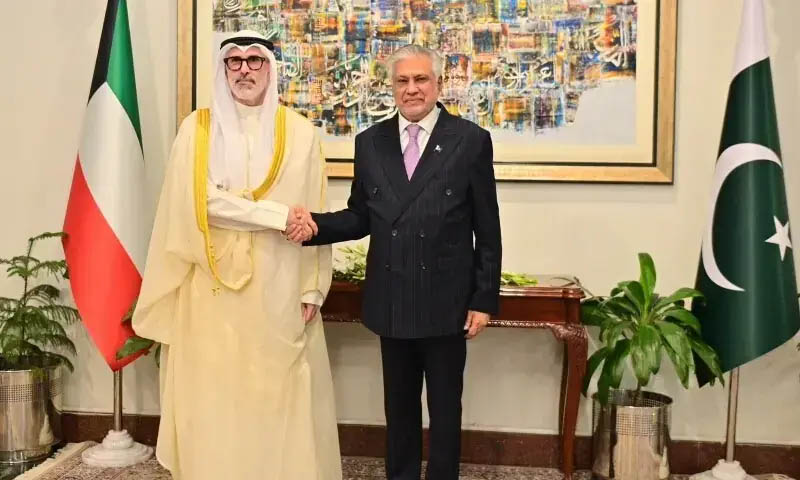
The official visit of Kuwait’s Foreign Minister to Pakistan comes at a crucial time for the Middle East, where security challenges, geopolitical competition, and economic uncertainty continue to reshape regional alliances. More importantly, the visit follows Kuwait’s formal ratification of the Defence Cooperation Agreement originally signed between Pakistan and Kuwait in June 2023. Although the agreement was concluded three years ago, its formal implementation now reflects the changing strategic environment in the Gulf and the growing importance of Pakistan as a reliable security partner.
Pakistan and Kuwait have traditionally enjoyed cordial diplomatic relations based on mutual respect, Islamic brotherhood, and people-to-people contacts. Thousands of Pakistanis have contributed to Kuwait’s development over several decades, while Kuwait has consistently supported Pakistan in various sectors, including humanitarian assistance, development financing, and investment. Defence cooperation therefore represents a natural extension of an already trusted relationship.
The defence agreement itself is not a conventional military alliance requiring either country to automatically enter a war on behalf of the other. Instead, it provides an institutional framework for cooperation in military education, professional training, intelligence sharing, logistics, defence technology, scientific research, defence industries, electronic communication systems, and joint exercises. Such arrangements are increasingly common among friendly states seeking to improve preparedness without compromising their sovereign decision-making.
The timing of the agreement is particularly significant. The Gulf region has witnessed heightened tensions in recent years due to conflicts involving Iran, maritime security concerns, drone and missile threats, cyber warfare, and instability affecting regional energy routes. In this environment, smaller Gulf states are seeking dependable partners capable of strengthening institutional defence cooperation and enhancing professional military capabilities.
Pakistan occupies a unique position in this strategic equation. It possesses one of the most experienced armed forces in the Muslim world, extensive operational experience in conventional and counter-terrorism operations, internationally respected military training institutions, and growing indigenous defence production capabilities. Pakistani military academies have trained officers from many friendly countries, while Pakistan’s participation in United Nations peacekeeping missions has enhanced its global reputation as a responsible security partner.
For Kuwait, cooperation with Pakistan offers several important advantages.
First, it provides access to high-quality military training at comparatively lower cost. Pakistan’s defence institutions have earned recognition for producing disciplined and professionally competent officers and soldiers.
Second, intelligence cooperation can significantly strengthen Kuwait’s ability to counter terrorism, organised crime, cyber-enabled threats, and transnational security challenges.
Third, Pakistan’s growing defence industry offers opportunities for collaboration in defence technology, maintenance, logistics, and specialised equipment.
Fourth, joint military exercises and regular exchanges help improve interoperability, crisis management capabilities, and emergency preparedness.
Pakistan also stands to benefit considerably from this partnership.
One immediate advantage is the strengthening of Islamabad’s strategic footprint in the Gulf region. Kuwait is an influential member of the Gulf Cooperation Council (GCC), and deeper defence ties with Kuwait reinforce Pakistan’s image as a dependable partner for Gulf security.
Secondly, stronger strategic relations often create favourable conditions for expanding trade, investment, energy cooperation, and labour opportunities. Kuwait remains an important energy producer, while Pakistan continues to seek long-term energy security and greater foreign investment. Strategic confidence frequently serves as the foundation upon which broader economic cooperation is built.
Thirdly, the agreement has the potential to support Pakistan’s indigenous defence industry. Collaboration in defence manufacturing, technical services, maintenance, and research could open new opportunities for Pakistani defence enterprises while generating valuable foreign exchange earnings.
Another important benefit lies in diplomacy. Pakistan has consistently attempted to maintain balanced relations with all major countries in the Middle East. It enjoys close ties with Saudi Arabia, the United Arab Emirates, Qatar, Türkiye, and increasingly constructive relations with Kuwait, while simultaneously maintaining diplomatic engagement with Iran. Such balanced diplomacy enhances Pakistan’s credibility as a bridge-builder rather than a source of regional rivalry.
The agreement also reflects a broader transformation in the regional security architecture. Traditional security arrangements in the Gulf are evolving as countries diversify their strategic partnerships. Instead of relying exclusively on one external power, Gulf states are increasingly expanding cooperation with trusted regional partners capable of contributing to defence preparedness, military education, intelligence coordination, and technological collaboration.
This does not necessarily mean that Pakistan will deploy combat forces or become directly involved in regional conflicts. Publicly available information indicates that the agreement focuses primarily on institutional cooperation rather than automatic military intervention. That distinction is important because it allows both countries to strengthen defence relations while preserving independent foreign policy choices.
From Pakistan’s perspective, the agreement complements its long-standing policy of supporting peace, stability, and collective security in the Muslim world. Pakistan has repeatedly demonstrated its commitment to regional stability through peacekeeping operations, military diplomacy, humanitarian assistance, and professional military exchanges.
There are also important economic dimensions that should not be overlooked. Security cooperation often encourages investor confidence. When political trust and institutional cooperation deepen, businesses generally become more willing to invest in infrastructure, energy, logistics, and technology. Kuwait’s sovereign investment capacity could therefore become increasingly relevant for Pakistan’s long-term economic development if both countries continue expanding their strategic partnership.
Nevertheless, the success of this cooperation will depend on careful implementation. Both governments must ensure regular meetings of the joint military committee, continuous professional exchanges, transparent cooperation mechanisms, and practical projects in training, research, cyber resilience, and defence technology. The agreement should remain focused on strengthening regional stability rather than contributing to geopolitical confrontation.
In conclusion, the Pakistan–Kuwait Defence Cooperation Agreement represents much more than a routine military understanding. It symbolises mutual confidence between two friendly Muslim nations seeking to respond collectively to an increasingly complex security environment. For Kuwait, the agreement strengthens institutional defence capabilities and expands strategic options. For Pakistan, it enhances regional influence, creates opportunities for defence exports, encourages economic cooperation, and reinforces its role as a responsible contributor to peace and stability in the Gulf. If implemented with strategic vision and mutual respect, this partnership can become an important pillar of Pakistan–Kuwait relations for many years to come.