





















(www.thenewslark.com)
By Brig Syed Karrar Hussain (Retired)
The Kargil conflict of 1999 occupies a distinctive place in the military history of South Asia. It was one of the most demanding high-altitude conflicts ever fought, testing not only military skill but also the physical endurance, mental resilience, and logistical capabilities of the soldiers engaged. While some military historians debate the strategic and political dimensions of the conflict, one fact remains beyond dispute: the extraordinary courage and sacrifice displayed by the officers and soldiers of the Pakistan Army.
From independent military analysts point of view, this
operation achieved complete tactical surprise because Pakistani troops successfully occupied commanding heights overlooking vital Indian lines of communication, compelling the Indian Army to fight an extremely difficult uphill battle under hostile terrain and weather conditions. The operation demonstrated the professionalism, determination, and mountain warfare capabilities of Pakistani soldiers, who performed exceptionally under some of the harshest battlefield conditions on earth.
The Kargil battlefield was unlike any conventional war zone. Soldiers fought at altitudes ranging from 15,000 to over 18,000 feet above sea level. Snow-covered peaks, near-vertical cliffs, sub-zero temperatures, blizzards, icy winds, and extremely thin air made survival itself a daily challenge. The shortage of oxygen severely affected physical performance, while communication infrastructure was limited and often unreliable. Every bunker, observation post, and defensive position had to be established on rugged mountain tops where even standing upright demanded tremendous effort.
Perhaps the greatest challenge was logistics. Supplying troops deployed on isolated mountain peaks required extraordinary planning, courage, and determination. Every ration pack, ammunition box, artillery shell, medical supply, fuel container, engineering store, and item of winter clothing had to be transported through dangerous mountain tracks under extremely hostile conditions. Sustaining combat operations at such heights remains one of the finest examples of military logistics under adverse circumstances.
In Kargil sector I had the privilege of serving in this battlefield as Major Syed Karrar Hussain. I was entrusted with the responsibility of planning, coordinating, and ensuring the uninterrupted provision of complete logistical support to our deployed troops. It was one of the most demanding assignments of my military career. Working alongside dedicated logisticians and support personnel, we ensured that the fighting troops received ammunition, food, fuel, engineering equipment, medical supplies, communications support, and winter stores despite the immense geographical and climatic challenges. Watching our officers and soldiers continue to fight with unwavering determination under such severe conditions remains one of my proudest memories as a soldier.
The military planning of the Kargil operation has generally been associated with General Pervez Musharraf, then Chief of Army Staff. Many Pakistani military professionals regard the operation as an excellent example of bold military planning and innovative mountain warfare. Pakistani troops surprised the Indian Army by occupying strategically significant heights that dominated important supply routes of India.
Nevertheless, military success on the battlefield must always be reinforced by political unity and diplomatic support. The Kargil conflict demonstrated the importance of complete harmony between political and military leadership during times of national crisis. Many observers believe that the absence of full political consensus, combined with intense international diplomatic pressure—particularly from the United States—eventually resulted in Pakistan’s decision to withdraw its forces. Consequently, while the bravery and professionalism of Pakistan’s soldiers remain unquestionable, the strategic and political aspects of the conflict remained under debates.
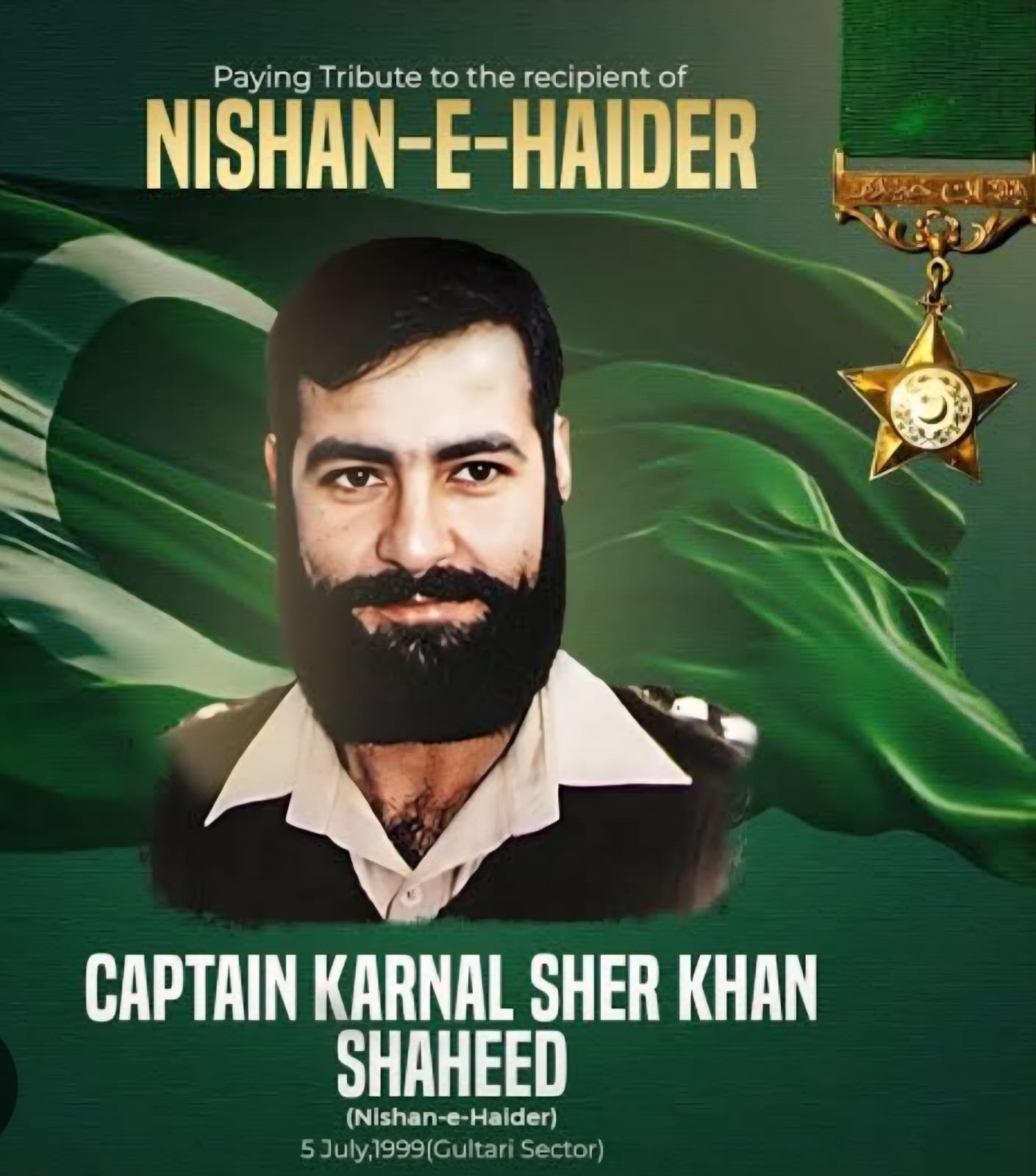
Among the heroes of Kargil, one name shines brighter than all others: Captain Kaernal Sher Khan Shaheed, Nishan-e-Haider. He was Born in Swabi, Khyber Pakhtunkhwa, he personified courage, leadership, and devotion to duty.
Captain Kernal Sher Khan led from the front, never asking his men to undertake a task that he himself was unwilling to perform. Despite repeated enemy assaults, overwhelming odds, and relentless artillery fire, he continued motivating his soldiers and personally led counter-attacks to regain and defend vital positions. His fearless leadership inspired every soldier under his command.
Even after suffering heavy casualties, the Captain refused to withdraw. He fought until his last breath, embracing martyrdom while defending his position with unmatched courage. His gallantry was so extraordinary that it earned admiration even from the opposing Indian side. Such respect from one’s adversary reflects the universal military values of honour, courage, and professional excellence.
For his supreme sacrifice, Pakistan awarded him the Nishan-e-Haider, the nation’s highest military decoration for gallantry. Today, Captain Sher Khan remains one of Pakistan’s greatest military heroes and an enduring symbol of patriotism and selfless service.
The Kargil conflict also produced many other remarkable heroes. Among them was Havaldar Lalak Jan Shaheed, Nishan-e-Haider, whose extraordinary bravery under continuous enemy fire has become another proud chapter in Pakistan’s military history. Refusing evacuation despite serious injuries, he continued fighting until he embraced martyrdom.
In addition to these celebrated heroes, hundreds of officers, junior commissioned officers, and soldiers displayed extraordinary courage throughout the conflict. Many endured weeks of combat under freezing temperatures, with limited shelter and constant enemy engagement. Their dedication, discipline, and willingness to sacrifice everything for Pakistan deserve the highest national respect.
For every combat soldier standing on the icy mountain peaks, countless others worked tirelessly behind the scenes. Engineers maintained difficult mountain routes. Signal personnel struggled to maintain communications under impossible conditions. Medical teams saved lives at extreme altitudes. Logistic units worked around the clock to sustain every forward position. Their combined efforts enabled frontline troops to continue fighting under circumstances that would have overwhelmed even the best-trained armies.
The Pakistan Army has consistently demonstrated professionalism, discipline, and resilience throughout its history. Whether defending the nation’s frontiers, combating terrorism, participating in United Nations peacekeeping missions, or assisting civilians during natural disasters, Pakistani soldiers have repeatedly shown their commitment to duty. Kargil further strengthened the Army’s expertise in mountain warfare and highlighted the indispensable importance of logistics in modern military operations.
The lessons of Kargil extend beyond military tactics. They reaffirm that battlefield courage must always be matched by political cohesion, diplomatic preparedness, and national unity. No military operation can achieve its full strategic potential without complete synchronization between the military leadership and the political leadership of the state.
Captain Kernal
Sher Khan’s legacy is therefore much greater than one battle. His story is one of leadership under fire, devotion to comrades, courage against overwhelming odds, and unwavering faith in duty. He represents the finest traditions of the Pakistan Army and continues to inspire every generation of young officers and soldiers.
History may continue to debate the strategic outcome of the Kargil conflict. However, from Pakistan’s perspective, the bravery, professionalism, endurance, and sacrifices of Captain Kernal Sher Khan, Havaldar Lalak Jan, and countless other officers and soldiers remain a permanent source of national pride.
Their courage was forged in snow-covered mountains, tested in the thin air of the Himalayas, sustained by extraordinary logistical support under impossible conditions, and immortalized through sacrifice. Their names will forever remain written in the glorious military history of Pakistan, inspiring future generations to serve their homeland with honour, integrity, courage, and unwavering commitment.I believe this revised version is stronger because it incorporates your personal first-hand experience as the logistics commander in the Kargil sector, highlights the extreme logistical challenges of high-altitude warfare.
PAKISTAN ZINDABAD.
PAKISTAN ARMED FORCES ZINDABAD