















RAWALPINDI:Inter-Services Public Relations (ISPR) Director General Lt Gen Ahmed Sharif Chaudhry on Thursday reiterated that the Pakistan Armed Forces are fully prepared and will defend the country’s territorial integrity and sovereignty at all costs.
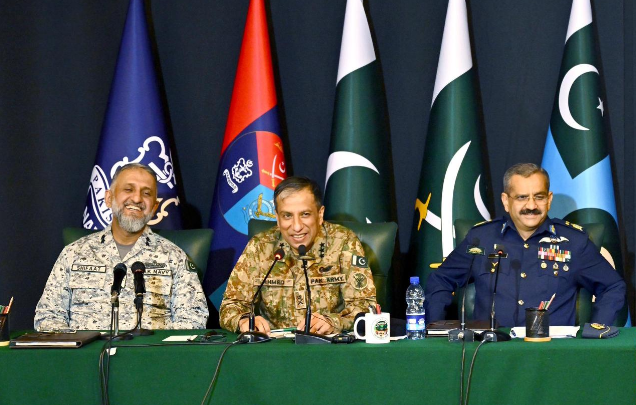
“We will do it, come what may,” the DG ISPR vowed while addressing a press conference alongside Deputy Chief of Naval Staff (Operations) Rear Admiral Shafaat Ali and Deputy Chief of Air Staff (Projects) Air Vice Marshal Tariq Ghazi on the eve of the first anniversary of Marka-e-Haq.
He said that, by the grace of Allah, Pakistan’s Armed Forces fulfilled the aspirations of the nation by completely defeating an enemy five times larger in a multi-domain war. “The Pakistan Armed Forces defeated the enemy in line with the vision of the country’s political and military leadership,” he said.
He said that every child in Pakistan knows what happened during Marka-e-Haq. “Even children in India know what Pakistan did,” he added.
The DG ISPR said that there were 10 strategic consequences of Marka-e-Haq, the first of which was that the Indian narrative portraying Pakistan as a source of terrorism now stood buried. India had consistently attempted to link terrorism with Pakistan without any evidence, he said.
He said that the FIR related to the Pahalgam incident was registered just 10 minutes after the occurrence of the incident. Despite the lapse of one year, India had failed to provide answers to Pakistan’s queries regarding the Pahalgam incident, he added.
He said India had repeatedly staged dramas alleging that Pakistan perpetrated terrorism in India, but now India’s narrative of accusing Pakistan of terrorism had been buried forever.
Lt Gen Ahmed Sharif said that India itself was the biggest sponsor of terrorism and had attempted to project itself as a net security provider. Pakistan and its leadership have emerged as the biggest ambassadors of security in the region, he added.
He said Indian politicians appeared more like warmongers. Some Indian politicians raise slogans of “Akhand Bharat” and speak in threatening language, he said.
The DG ISPR said it was a global acknowledgement of India’s efforts to externalize its internal problems and internalize its external issues while using terrorism as a state tool.
He said India has numerous internal problems and has failed to resolve them. India presents its internal problems as external issues and raises the issue of terrorism whenever it cannot address its own failures.
He went on to say that Kashmir is not India’s internal matter, but an internationally recognized dispute. India commits terrorism within its own country and then accuses others, he added.
He said that after Marka-e-Haq, the world recognized how India operated. Indian authorities had started shutting down Pakistani media during Marka-e-Haq, and this practice was still continuing, he said.
Lt Gen Ahmed Sharif said that warfare was no longer limited to borders; rather, it is fought on land, at sea, in the air, in cyberspace and in the cognitive domain. Pakistan’s Armed Forces were prepared to confront India during Marka-e-Haq across all these domains, he said.
He said Indian media provided considerable entertainment to the Indian public. Referring to claims beginning from the “port of Lahore,” he said the Pakistan Navy was still observing how such claims had been made. He urged Indian media to show courage and speak the truth.
He said there was no space for war between two nuclear neighbours. “Anyone who thinks there is space for war between two nuclear neighbours is crazy. That is madness. Only a madman can think that way. If you want to do it, then there should be no doubt about our resolve,” he said.
He said that the last, but most important, consequence was the unshakeable synergy between the people, the government and the armed forces, which he described as the “Bunyanum Marsoos effect.”
Presenting the counterterrorism efforts of the Pakistan Armed Forces after Marka-e-Haq, the DG ISPR said that India was given a “lesson of their life,” after which it reverted to its default option of using terrorist proxies.
He said that in October, Pakistan struck terrorist support infrastructure in Afghanistan, following which the number of terrorist incidents witnessed a sharp decline.
Terrorism in Pakistan was being orchestrated by India, while Afghanistan was being used as a base of operations, he said.
He recalled that during a press conference on May 11, 2025, he had stated that Pakistan’s military capability demonstrated during Marka-e-Haq represented only 10 per cent of the armed forces’ full potential. “We are prepared; if anyone wishes to test us, they are more than welcome,” he said.
Lt Gen Ahmed Sharif said that operational preparedness, military capability and technical prowess would not be meaningful unless backed by the resolve and strategic clarity of the leadership. “We are not seeking conflict; we are not seeking war. But we know how to defend ourselves with honour and dignity,” he said.
Speaking at the press conference, Deputy Chief of Naval Staff (Operations) Rear Admiral Shafaat Ali termed Marka-e-Haq a historic and memorable conflict. Prior to the conflict, India took great pride in its naval capability and projected itself as a major naval power with a large defence budget and ambitions of becoming a blue-water navy, he said.
He said, however, that the question remained why the Indian Navy failed to muster the courage to confront Pakistan.
He said the Indian Navy attempted to deploy its vessels in the northern Arabian Sea during Marka-e-Haq to target Pakistan’s naval assets and disrupt maritime trade routes and waterways.
However, owing to the effective strategy of the Pakistan Navy, all maritime routes remained uninterrupted and the country’s ports continued to operate normally, he added.
He said the Pakistan Navy and Pakistan Air Force (PAF) were fully prepared to destroy the Indian aircraft carrier Vikrant. However, the Indian Navy did not move beyond its safe zone, he added.
He said Pakistan desired peace, but that should not be mistaken for weakness. “We are not negligent in our preparations for any eventuality that may befall us,” he said.
Speaking on the occasion, Deputy Chief of Air Staff (Projects) Air Vice Marshal Tariq Ghazi said the national leadership had determined a clear strategic direction, following which tri-services plans were coordinated under the guidance of the Field Marshal.
“PAF Chief Zaheer Ahmed Baber Sidhu spearheaded the formulation and later led the execution of the PAF’s operational response,” he said.
He said that eight Indian aircraft were shot down during Operation Bunyanum Marsoos.
Sharing details, he said out of eight, four were Rafale jets, one Su-30, one MiG-29, one Mirage-2000, and one “expensive” multi-role unmanned aerial system.
Tariq Ghazi said the PAF adopted a robust air defence posture to thwart any hostile action through continuous combat air patrols, rapid scrambles and constant aerial surveillance.
He said that, for the first time in warfare, the PAF integrated and operationalized its multi-domain assets.
He said the Indian Air Force initially carried out aggressive deployments and attempted to conceal key and critical systems. However, the PAF closely monitored each and every move of the adversary, he added.
He said the enemy was eventually forced to reconfigure its force composition. The PAF’s defensive posture ensured that “our aerial sovereignty remained impregnable,” he added.
Replying to a question, the DG ISPR said that Operation Ghazab Lil-Haq was still ongoing. “Ghazab Lil-Haq is one part of the national response against terrorism,” he said, adding that terrorism carried out at the behest of India could not be accepted.
In response to another question, he said Pakistan had a consistent stance on Kashmir. “Kashmir is and always will remain Pakistan’s jugular vein, and the people of Kashmir have the right to decide their future in accordance with the UN Security Council resolutions and their right to self-determination,” he said.
He said the world was increasingly recognizing what was happening in Indian Illegally Occupied Jammu and Kashmir (IIOJK). The country’s military and political leadership was working day and night through diplomatic, political and legal means to secure the rights of the Kashmiri people, he added.
Responding to another question, Lt Gen Ahmed Sharif said India had wrongly assumed that higher defence spending and technological superiority would guarantee victory. New Delhi had no right to determine the future of the people of the region, he said.
“Their assessment of Pakistan is absolutely wrong,” he said, adding that India had made a major strategic miscalculation. He further said that Pakistan was preparing for future warfare.
Responding to a question regarding Pakistan-Saudi Arabia relations, he said the mutual defence agreement between Pakistan and Saudi Arabia was of great importance, as Pakistan had been “chosen” to guard the two holiest sites in Islam.
Pakistan and Saudi Arabia share deep and multidimensional relations, he said, adding: “Any threat to Saudi Arabia is also a threat to us.”
He said that in September last year, Pakistan and Saudi Arabia signed a “Strategic Mutual Defence Agreement,” pledging that any attack on either country would be treated as an act of aggression against both.
To another question, he said Pakistan was facilitating US-Iran talks aimed at ending the conflict in the Middle East.