
















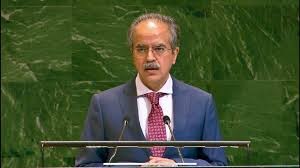
UNITED NATIONS:Pakistan’s Ambassador to the United Nations, Asim Iftikhar Ahmad, Friday called for strengthened multilateral cooperation and coordinated global responses to counter the growing and evolving threat of terrorism in all its forms and manifestations at an event held at UN Headquarters in New York.
“We must enhance information-sharing, build resilient digital ecosystems, and ensure that international frameworks are updated to address the evolving nexus between terrorism and technology,” he told participants at the event organized by the Permanent Mission of Pakistan and the United Nations Office of Counter Terrorism (UNOCT).
In his opening remarks, the Pakistani envoy underscored the need to deal with the root causes of extremism, including xenophobia, racism, and intolerance that fuel cycles of violence. “Only through collective resolve, strengthened partnerships, and a renewed commitment to the principles of the UN Charter can we hope to effectively confront and defeat the threat of terrorism in the digital age.”
Friday’s event on “New and Emerging trends in terrorism” provided a platform for exchange of views from varying perspectives presented by diplomats, UN policy experts, civil society, and counter terrorism experts from the private sector and academia. It was co-chaired by Ambassador Asim Ahmad and the UN’s Acting Under Secretary General of the UNOCT, Alexander Zouev.
Rafi Shah, Chief of UNOCT’s Policy, Knowledge Management and Coordination Branch moderated the discussion..
Panelists included Chinese Ambassador Fu Cong; the Coordinator for the Analytical Support and Sanctions Monitoring Team, Colin Smith; the Member of UN’s Independent International Commission of Inquiry on Syria and former Special Rapporteur on counter-terrorism and human rights, Professor Fionnuala Ni Aolain; the Clinical Assistant Professor, New York University’s Center for Global Affairs, Dr. Olajumoke Ayandele; UNOCT’s Human Rights and Gender Section, Ms. Krisztina Huszti-Orban; the Resident Senior Fellow for South Asia, Atlantic Council, Michael Kugelman; the Executive Director of Global Internet Forum to Counter Terrorism (GIFCT), Ms. Naureen Chowdhury Fink; and the Principal Strategic Advisor to Christchurch Call Foundation, Ms. Mackenzie Rice.
In his remarks , Ambassador Asim Ahmad gave an overview of the fast evolving threat landscape, xenophobia, racism and other forms of intolerance, or in the name of religion or belief, gaps in the global counter terrorism architecture and sanctions regimes, limitations for national governments to combat threats beyond national jurisdictions and challenges towards accountability of commercial social media platform providers and technology companies. He also gave an overview of regional perspectives and increasing use of modern means by terrorist groups to orchestrate terrorist attacks and shed light on the sacrifices made by Pakistan in the fight against terrorism.
Pakistan, he said, has remained at the forefront of global counter-terrorism efforts, bearing a heavy cost in terms of human lives, economic losses, and damage to critical infrastructure. He cited the recent Global Terrorism Index, which places Pakistan among the countries most impacted by terrorism in 2025, particularly in the aftermath of the Taliban’s return to power in Afghanistan. .
The Pakistan envoy said that groups such as Tehrik-i-Taliban Pakistan (TTP) and the Baloch Liberation Army (BLA), including its Majeed Brigade, have intensified their activities, increasingly leveraging ICTs and social media platforms to propagate their narratives and coordinate attacks. He said that the 2025 Jaffar Express incident, in which over 400 passengers were taken hostage, stands as a stark example—not only of the brutality of such groups but also of the parallel information warfare waged through disinformation and the circulation of fake videos, even as rescue operations were underway.
On his part, Acting USG Zouev said that terrorism has become multipolar and sophisticated as he advocated preventive action to address the new and emerging threats such as AI that introduce new risks, including through encrypted services and digital assets.
He emphasized the need to have such discussions in order to draw attention to these trends that are shaping the contemporary terrorism environment that includes the digitization of terrorist activity and exploitation of these spaces.
Other speakers highlighted the threats posed by modern information and communication technologies (ICTs), such as abuse of social media platforms, terrorist propaganda and disinformation, Xenophobia, Artificial Intelligence (AI) tools, use of virtual assets and digital wallets such as crypto currencies, the challenges they pose for national governments, particularly due to jurisdictional complexities in the cyberspace owing to the borderless nature of the internet and limited efficiency of traditional law enforcement and judicial cooperation as well as the need for adequate safeguards and enhanced global cooperation.
The speakers underscored the importance of addressing root causes of instability and terrorism and the need for taking preventive action in a timely manner. They highlighted the threat and rise of the far right and right-wing extremist ideologies, alongside the proliferation of hate speech, problems of definition and terrorist propaganda that has given fresh impetus to a rising wave of violent attacks around the world.
In this regard, they stressed on the need to find solutions for the lawful removal of harmful content in collaboration with technology companies.
Discussions also focused on key global hotspots for terrorism, terrorism against communities living under occupation and the prevalent threat from terrorist groups based in Afghanistan such as the TTP, BLA and the Majeed Brigade, ETIM and ISIL-K and groups such as the JNIM operating in West Africa and the Sahel.
This event was organized as part of Pakistan’s firm commitment to facilitate dialogue and foster discussions at multilateral platforms on finding practical ways to address the growing and evolving threat of terrorism, in all its forms and manifestations, through a comprehensive approach at the national regional and global level, press release of the Pakistan Mission said. Counter terrorism is one of Pakistan’s key priorities during its present term as an elected member of the UN Security Council for the term 2025-26.
The convening of this event comes at a time when the UN General Assembly is in the process of negotiating the 9th review of the Global Counter Terrorism Strategy (GCTS).