















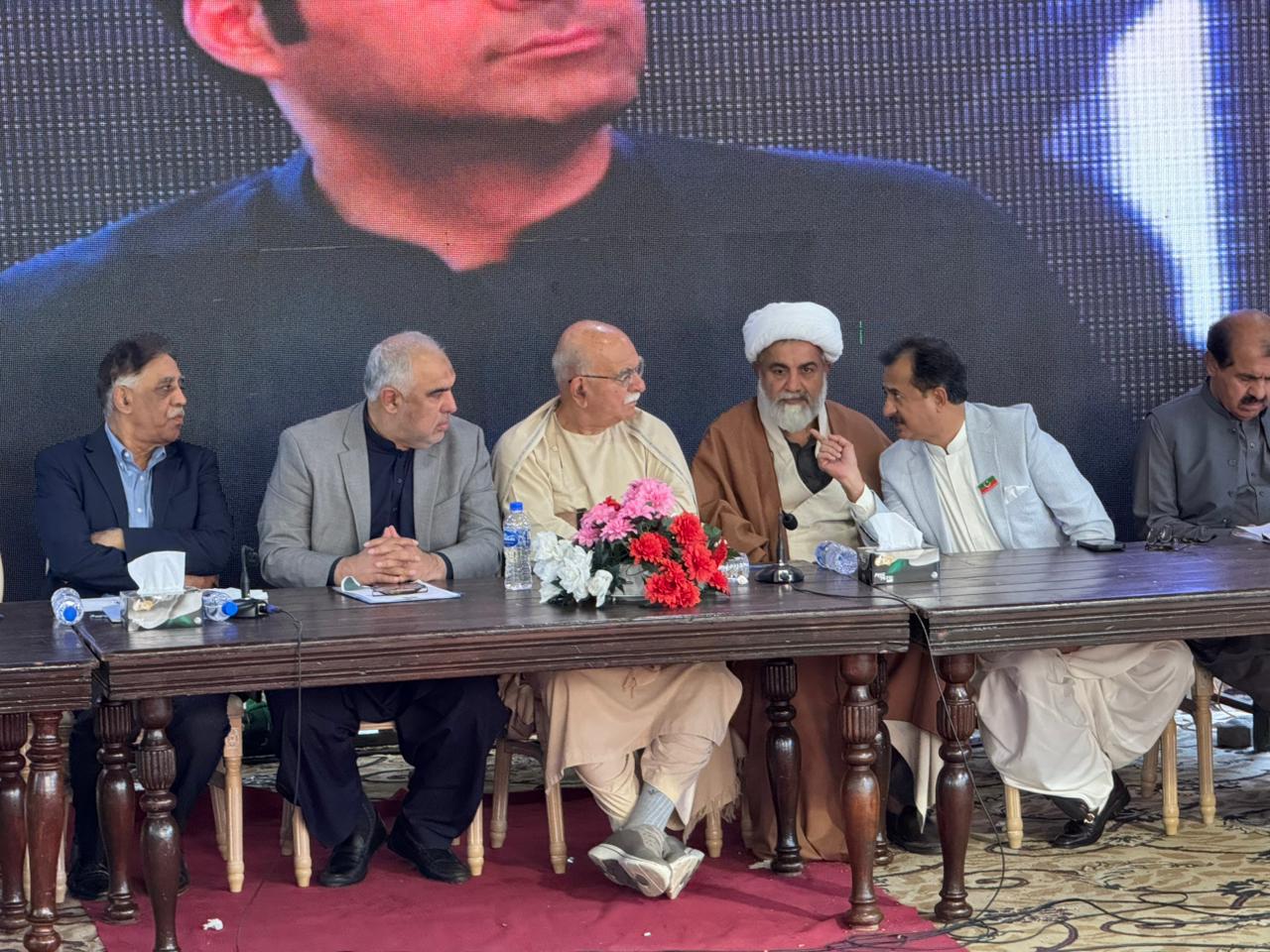
Karachi:An All Parties Conference (APC) convened under the banner of the Tehreek Tahaffuz Aain Pakistan (Movement for the Protection of the Constitution of Pakistan) was held at the Karachi Press Club on Sunday, drawing wide participation from political parties, nationalist groups, lawyers, journalists and civil society representatives. The conference was presided over by Mahmood Khan Achakzai, chairman of the Tehreek Tahaffuz Aain Pakistan and Leader of the Opposition in the National Assembly.
Among the prominent participants were Leader of the Opposition in the Senate Allama Raja Nasir Abbas, former National Assembly speaker Asad Qaiser, Sindh United Party president and vice-chairman of the movement Syed Zain Shah, PTI Sindh president Haleem Adil Sheikh, former finance minister Miftah Ismail, former Sindh governor Mohammad Zubair Umar, Senator Mushtaq Ahmed, GDA leader Safdar Abbasi, PMLF General secretary Sardar Abdul Rahim, PTI Sindh general secretary Dr Masroor Sial, PTI Karachi president Raja Azhar, general secretary Arsalan Khalid, Sindh Assembly parliamentary leader Shabeer Qureshi, MPA Rehan Bandukda, Sarena Adnan, Fizza Zishan, Fauzia Siddiqui, Advocate Mazhar Rahoojo of the Qaumi Awami Tehreek, Sindh Bar Council member Barrister Salahuddin, former Karachi Bar Association president Aamir Nawaz Warraich, Jamaat-i-Islami Sindh deputy amir Hafiz Nasrullah Channa, and leaders of the Balochistan National Party, Jeay Sindh Mahaz, Awami Democratic Party and JUI (Sherani group), among others.
Comprehensive resolution adopted
At the conclusion of the conference, participants unanimously adopted a detailed and comprehensive resolution expressing grave concern over what they described as Pakistan’s deepening constitutional, political, economic and human rights crises.
The resolution stated that democracy rests on transparent and fair elections, and called for the immediate appointment of a neutral chief election commissioner and the conduct of fresh, credible elections under a reconstituted Election Commission. It demanded independent and transparent investigations into what it termed “massive rigging” in the February 8, 2024 elections, with accountability of those responsible under Article 6 of the Constitution.
Strongly criticising governance in Sindh, the resolution cited incidents such as the Gul Plaza fire in Karachi, worsening lawlessness in interior Sindh, rising traffic fatalities in Karachi, children dying after falling into open drains, acute water shortages, broken roads and the absence of basic civic facilities as clear evidence of provincial government failure.
The APC condemned what it called sustained attacks on judicial independence, alleging that the 26th and 27th constitutional amendments were used to weaken the judiciary through pressure and arbitrary transfers. It expressed concern over the treatment of judges including Justice Mansoor Ali Shah, Justice Athar Minallah and Justice Shams Mehmood Mirza, and condemned recent actions against Justice Tariq Jahangiri as another example of interference in judicial affairs.
Demand for release of political prisoners
Terming cases and convictions against PTI founder Imran Khan, Bushra Bibi and other opposition leaders as politically motivated, the resolution demanded the immediate release of all political prisoners, including Imran Khan, Bushra Bibi, Shah Mahmood Qureshi, Senator Ejaz Chaudhry, Dr Yasmin Rashid, Umar Sarfaraz Cheema, Mian Mehmoodur Rasheed, Sahibzada Hamid Raza, Hassan Niazi, Ali Wazir, Haji Abdul Samad, Wali Mohmand, Dr Mahrang Baloch, detainees of the Baloch Yakjehti Committee, GDA’s Murtaza Jatoi and Sindh United Party’s Syed Zain Shah. It also called for lifting restrictions on meetings with Imran Khan and withdrawal of all politically motivated cases.
The resolution rejected the Prevention of Electronic Crimes Act (Peca) as a “black law” curbing freedom of expression and demanded its immediate repeal. Expressing solidarity with journalists, the APC condemned alleged economic pressure on Dawn TV, cases against journalist Matiullah Jan, and the dismissal of journalists for speaking out. It also termed cases against lawyers Imaan Mazari and Ali Hadi as political victimisation and called for transparent trials.
Economic crisis and regional issues
The APC noted that economic stability was impossible without political stability, citing World Bank assessments that a large segment of Pakistan’s population had fallen below the poverty line, while unemployment, industrial closures and capital flight were on the rise. It urged the government to announce immediate public relief measures.
The resolution described enforced disappearances as a grave violation of the Constitution and fundamental human rights, demanding their immediate end. On Khyber Pakhtunkhwa, it called for implementation of decisions taken at a provincial jirga, an end to military operations in Tirah Valley, consultation with the provincial government, and resolution of issues related to Afghanistan through diplomatic means.
Reaffirming provincial autonomy, the resolution stated that provinces had the first right over their minerals and natural resources, and that international agreements without public consent were unconstitutional. It emphasised adherence to the 1991 Water Accord and rejected projects obstructing the natural flow of rivers.
Expressing concern over regional and international developments, particularly in Iran and Gaza, the APC called on the government to convene an emergency meeting of regional states and a joint session of parliament. It also rejected proposals to raise the voting age from 18 to 25, terming them an attack on youth democratic rights.
The resolution expressed condolences over the deaths of youths during protests for river and water protection in Moro, and demanded the immediate release of those arrested and removal of obstacles to bail.
Future course of action
Announcing a joint course of action, the APC declared that February 8, 2026 would be observed nationwide as a “black day” to mark two years since what it called the theft of the public mandate. It announced countrywide wheel-jam and shutter-down strikes, hoisting of black flags and peaceful protests to demand the restoration of the Constitution, democracy and the people’s right to rule.
Leaders’ speeches
In his presidential address, Mahmood Khan Achakzai described Karachi as a city of knowledge and resistance, and Sindh as a land that had always stood against oppression. He stressed that Pakistan could only be strengthened through respect for all nationalities, cultures and religions, and said the federation could not be stable without granting provinces their constitutional rights and control over resources. He urged citizens to come out peacefully on February 8 to demonstrate unity and awareness.
Tehreek Tahaffuz Aain Pakistan Secretary General and former NA speaker Asad Qaiser said Karachi, the country’s largest economic hub, had seen its mandate “stolen”. He said Imran Khan had been jailed for over two years in what he called fabricated cases, but remained steadfast. Without adherence to the Constitution and rule of law, he warned, public resistance would intensify.
Allama Raja Nasir Abbas said standing against oppression was the duty of every Pakistani. He noted that the Constitution reflected people’s aspirations, but institutions such as the judiciary, parliament and media were under pressure. He appealed especially to youth to participate peacefully on February 8.
Syed Zain Shah said the country was facing a severe political, economic and constitutional crisis, with parliament reduced to a rubber stamp and media and judicial freedoms curtailed. He said Sindh’s civic conditions were deteriorating rapidly and described the February 8 movement as decisive.
PTI Sindh president Haleem Adil Sheikh welcomed participants and criticised heavy police deployment around the press club as a sign of authoritarianism. He said the Constitution had been “broken” and restoring it was now the movement’s central responsibility, adding that the release of Imran Khan and all political prisoners was the nation’s foremost demand.
Former governor Mohammad Zubair Umar said economic stability was impossible without political stability, alleging large-scale electoral manipulation in Karachi. He stressed that investment and growth depended on rule of law and transparent elections.
Former senator Mushtaq Ahmed said Pakistan faced multiple challenges, including political instability, economic crisis, weakened democracy and rising terrorism, all rooted in the denial of the public mandate. He voiced serious concerns over enforced disappearances, military operations and political detentions.
Former finance minister Miftah Ismail highlighted worsening poverty, unemployment and inflation, saying shrinking incomes and soaring prices had pushed basic necessities beyond the reach of ordinary citizens. “Without fixing politics, the economy cannot recover,” he said.
Other speakers, including Dr Safdar Abbasi, Barrister Salahuddin, Aamir Nawaz Warraich, Mazhar Rahoojo, Firdous Shamim Naqvi, Sareena Adnan, Jabbar Khattak, Qadir Ranto, Sajid Tareen and Noor Nabi Rahoojo, reaffirmed their commitment to a joint struggle for constitutional supremacy, democracy, human rights and the protection of the public mandate.
The conference concluded with a renewed pledge that the Tehreek Tahaffuz Aain Pakistan would continue its struggle with full force to address the country’s crises, restore the Constitution and uphold the people’s right to govern.
Issued by: Adviser to the President, PTI Sindh